
Most detailers sit around waiting for leads to magically show up. You refresh your phone. You check Instagram. You wonder why nobody’s booking. And the whole time, you’ve got a neighbourhood full of dirty cars within walking distance.
If you’re still relying on word of mouth and hoping the algorithm blesses you, you don’t have a business. You have a hobby with expensive equipment.
Here’s the thing. You do not need paid ads to land your first 10, 20, even 30 clients. I built my first detailing business without spending a single dollar on advertising. And I still teach this exact approach to every new member inside the Academy. We call it the First 10 Playbook, and it works because it removes the waiting game entirely.
Let’s get into it.
The First 10 Playbook: Your Zero-Ad Client Acquisition System
The First 10 Playbook is the step-by-step framework I use to help new detailers land their first paying clients without any ad spend. It combines boots-on-the-ground outreach, a stacking Google review strategy, referral loops, and simple social media content to build a predictable, repeatable pipeline from scratch. No ad account needed.
Why “First 10”? Because once you’ve completed 10 paying jobs, you’ve got reviews, before-and-after photos, referral momentum, and the confidence to charge properly. Everything after that gets easier.
Most detailers I work with come to me at one to six months in. They’ve done a couple grand a month. They’ve moved past friends and family. But the leads aren’t showing up consistently. Sound familiar?
The problem isn’t your detailing skill. It’s that you don’t have a system for demand. The First 10 Playbook fixes that.
Step 1: Door Knocking Still Works. Seriously.
Door knocking is the fastest way to book paid work when you have zero marketing budget, zero online presence, and zero leads in your pipeline. It works because car detailing is a mobile local service business, and every driveway with a dirty car is a potential client standing 20 metres away.
I know. Nobody wants to hear this. It’s not glamorous. It’s not a funnel. But here’s what I tell every new member: “You can go out there and knock on 20 doors and you might book one customer for two hours of work.” That’s instant revenue. No algorithm. No waiting for a campaign to optimize. No cost per lead.
Is it scalable long term? No. But that’s not the point right now. The point is getting your first paying clients, building confidence, and stacking up the social proof you need for everything else to work.
Here’s how to do it without being weird about it:
- Target the right streets. Drive through neighbourhoods where you see newer cars, clean driveways, and double garages. These people spend money on their vehicles.
- Lead with value, not a pitch. Something like: “Hey, I run a mobile detailing business in the area. I’m offering a special intro rate this week. Noticed your car could use a clean, wanted to see if you’d be interested.”
- Carry a phone with photos. Show them a before-and-after from a previous job. Even if it was your own car or a family member’s vehicle, it builds trust instantly.
- Book on the spot. Don’t leave a flyer and hope. Get a date and time locked in before you walk away.
- Ask for a review before you leave the driveway. This is non-negotiable. We’ll cover why in a minute.
One detailer I coached was doing three or four cars in an entire month, all from word of mouth and the odd Google search. Full time detailing, almost no work coming in. The organic just wasn’t flowing. Within his first week of structured outreach, he had more conversations about his services than he’d had in the previous month combined. Same skill. Same area. Different approach.
Step 2: Stack Google Reviews Like Your Business Depends on It (Because It Does)
Google reviews are the single most important free asset a new detailing business can build. They drive local search visibility, they give strangers a reason to trust you before they’ve even spoken to you, and they compound over time. A detailer with 20 five-star reviews will beat a detailer with zero reviews in every search result, every time.
I push this hard with every new member. On your very first call with me, I’m asking: “Have you got a Google Business Profile set up? How many reviews have you got?”
Here’s the play I run, and it’s one I teach inside the Academy: after every single job, ask for a review in person. Then follow up with a message. The message says something like: “Hey, go in the draw to win a free detail by leaving a review. Winner will be announced when we get 100 reviews.”
I’ll do a free full detail to get 100 reviews any day. That’s the math. One free job in exchange for a hundred pieces of social proof that generate leads for years? That’s the best deal in your business.
Here’s your Google review stacking checklist:
- Set up your Google Business Profile properly. Correct business name, service area, categories, photos. This takes 15 minutes.
- Ask every single customer in person. Right after the job, while they’re staring at their clean car and feeling great. “Hey, would you mind leaving me a quick Google review? It really helps.”
- Send the follow-up message. Have a template saved. Include the direct review link. Mention the draw incentive.
- Respond to every review. Google notices. Customers notice. It signals you’re active and professional.
- Never stop. This isn’t a one-time campaign. Every job, every customer, every time.
One member I spoke with on his onboarding call had 18 Google reviews and was already appearing in the top three search results in his area. Another had 20 reviews, five stars, and clear proof his customers were happy. The work just wasn’t showing up consistently because he hadn’t paired that social proof with any kind of active outreach. Reviews alone aren’t enough. But reviews plus outreach? That’s where the compounding starts.
Step 3: Turn Every Job Into Two Jobs With a Referral Loop
A simple referral loop turns every completed detail into your next booking without you spending a dollar. When you deliver great work and then deliberately ask for referrals, you create a chain reaction that builds momentum faster than any ad campaign in your first few months.
I had a coaching client who did his first paid job for a neighbour. She recommended him to a friend. He did that job. Two more referrals came from it. Within a week, he had his weekend fully booked, all from one conversation with one neighbour.
That’s not luck. That’s how referral loops work when you actually ask.
The mistake most detailers make is doing a great job and then just… leaving. They don’t ask. They feel awkward. They assume the customer will tell people if the work is good enough. Sometimes they do. But “sometimes” doesn’t pay rent.
Here’s the referral framework I teach:
- Ask at the peak of satisfaction. Right when they see the finished car. Not a week later. Not via text. Face to face, in the moment. “Do you know anyone else who might want their car done? I’ve got availability this week.”
- Make it easy. “If you send them my number and they book, I’ll give you $20 off your next detail.” Simple. Clear. Valuable for them.
- Follow up with the referral fast. If someone gives you a name and number, contact them within hours, not days. Speed to lead applies everywhere, not just ads.
- Track it. Even if it’s just a note on your phone. Who referred who. This becomes gold later when you want to identify your best referral sources.
The beauty of referrals at this stage is they come pre-sold. The person who referred them has already done the selling for you. They trust their friend’s recommendation. Your close rate on referrals will be dramatically higher than cold outreach. That’s why this step is so powerful alongside door knocking. Knocking gets you the first job. Referrals get you the second and third.
Step 4: Post Content That Proves You Can Do the Work
Simple social media content, before-and-afters, short process videos, and real customer results, gives strangers proof you can do the work before they ever message you. You don’t need to go viral. You need to show up consistently with evidence that you’re a real business doing real work.
I’m not talking about spending hours on Reels transitions or buying a gimbal. I’m talking about pulling out your phone, snapping a before shot, doing the detail, snapping an after shot, and posting it with a caption like: “Full detail on this Mazda CX-5 today. Interior was rough. Came up sweet. DM me if you want yours done.”
That’s it. That’s the content strategy for your first 10 clients.
What I tell detailers inside the Academy is this: if you are making content and the content performs well, if it does get some reach, then we can use that as an ad later. So you’re not just building your organic presence. You’re building a library of proven creative that can be amplified with paid ads when the time is right.
Here’s what to post in your first 30 days:
- Before-and-after carousels. Side by side photos. Interior, exterior, or both. These perform the best consistently.
- Short process clips. 15-30 seconds of you vacuuming a filthy interior, extracting a seat, or polishing a panel. Satisfying content that people actually watch.
- Customer reaction moments. If a customer says “wow” when they see their car, ask if you can film a quick 10-second clip. Social proof on steroids.
- The “I’m available this week” post. Simple text post or story. “Got two spots open this week for full details in [your area]. DM me to book.” Direct. Clear. Works.
Post on your Facebook business page, Instagram, and even your personal Facebook profile. Your mates and their mates are all potential customers. Don’t overthink which platform. Just post where your local community actually hangs out.
Step 5: Make It a Numbers Game
Once you understand the numbers behind your detailing business, client acquisition becomes a simple math problem instead of a stressful guessing game. You don’t need hundreds of clients. You need the right number of the right clients at the right price.
Here’s something I break down on almost every strategy call. If your average order value is around $400 (which accounts for a mix of full details, some interior-only jobs, and the occasional higher-ticket service), then $5,000 divided by $400 equals 12.5 vehicles a month to hit $5,000. That’s roughly three cars a week.
You don’t need tons of work to get to $5,000 a month. You just need to be offering the right type of services and the right type of customers finding you.
Scale that up: 24 vehicles in a month at an average order value of around $400 puts you over $10,000. That’s six cars a week. Still completely doable as a solo operator.
So it becomes a bit of a numbers game when you break it down. The First 10 Playbook is designed to get those first 10-15 clients in the door so you can start tracking, learning, and building from real data instead of guessing.
Here’s what to track from day one:
- Doors knocked / conversations had. How many outreach attempts per week.
- Bookings from each source. Door knocking, referrals, Google, social media, other.
- Revenue per job. Track every single one.
- Google reviews collected. Aim for at least one per completed job.
- Referrals asked vs referrals received. Are you actually asking?
You can’t control what you don’t track. Even a simple spreadsheet or notes app is enough at this stage. But you need the numbers so you know what’s working and what’s wasting your time.
Why Ads Can Wait (But Won’t Wait Forever)
I’m not anti-ads. Far from it. Paid advertising on Meta and Google is a massive part of what I teach inside the Academy. But ads are an accelerant, not a foundation. If you pour fuel on a fire that isn’t lit, nothing happens. If you pour fuel on a burning fire, it gets big fast.
The First 10 Playbook is about lighting the fire.
Here’s what happens when detailers try to skip straight to ads without the foundation:
- They run a campaign with no reviews, no social proof, and no proven service. Leads come in but don’t convert.
- They don’t know how to follow up properly, so leads go cold.
- They don’t have the pricing dialed in, so they either underprice and burn out or overprice for their market and get ghosted.
- They stop and start campaigns because they can’t afford the spend, which tanks performance.
I see this constantly. One member I worked with was spending on ads but only getting one actual client from the whole campaign. The leads were coming in, but disconnected numbers, fake inquiries, people not responding. The issue wasn’t the ads. It was that the business fundamentals weren’t there yet.
Another common pattern: a detailer sets the price on their ad form way too high for where they are in the market, and the leads dry up completely. We had to remove the price from one member’s form entirely because the figure was scaring everyone off before they even submitted an inquiry. Immediately after the change, the pipeline started moving again.
The lesson? Get your first 10 clients manually. Build reviews. Build confidence. Figure out your pricing and your close process. Then, when you turn on ads, you’ve got a machine that can actually convert the leads into paying customers.
The Compound Effect: What Happens After Your First 10 Clients
Your first 10 clients create a flywheel that feeds itself: reviews generate search visibility, referrals generate warm leads, content generates social proof, and the combination makes every new client easier to land than the last. This is where the First 10 Playbook transitions from manual hustle into a self-sustaining system.
Here’s what the math looks like after 10 completed jobs:
- 10+ Google reviews. You’re now showing up in local search results. People searching “car detailing near me” are finding you.
- A referral network. If even half your clients referred one person, you’ve got five warm leads waiting.
- 10+ pieces of content. Before-and-afters, process videos, happy customers. Your social media looks like a real business.
- Pricing confidence. You’ve quoted, you’ve closed, you’ve learned what your market will pay. No more guessing.
This is the inflection point. This is where detailers go from “I hope someone calls me today” to “I’ve got three bookings this week and two more leads to follow up on.”
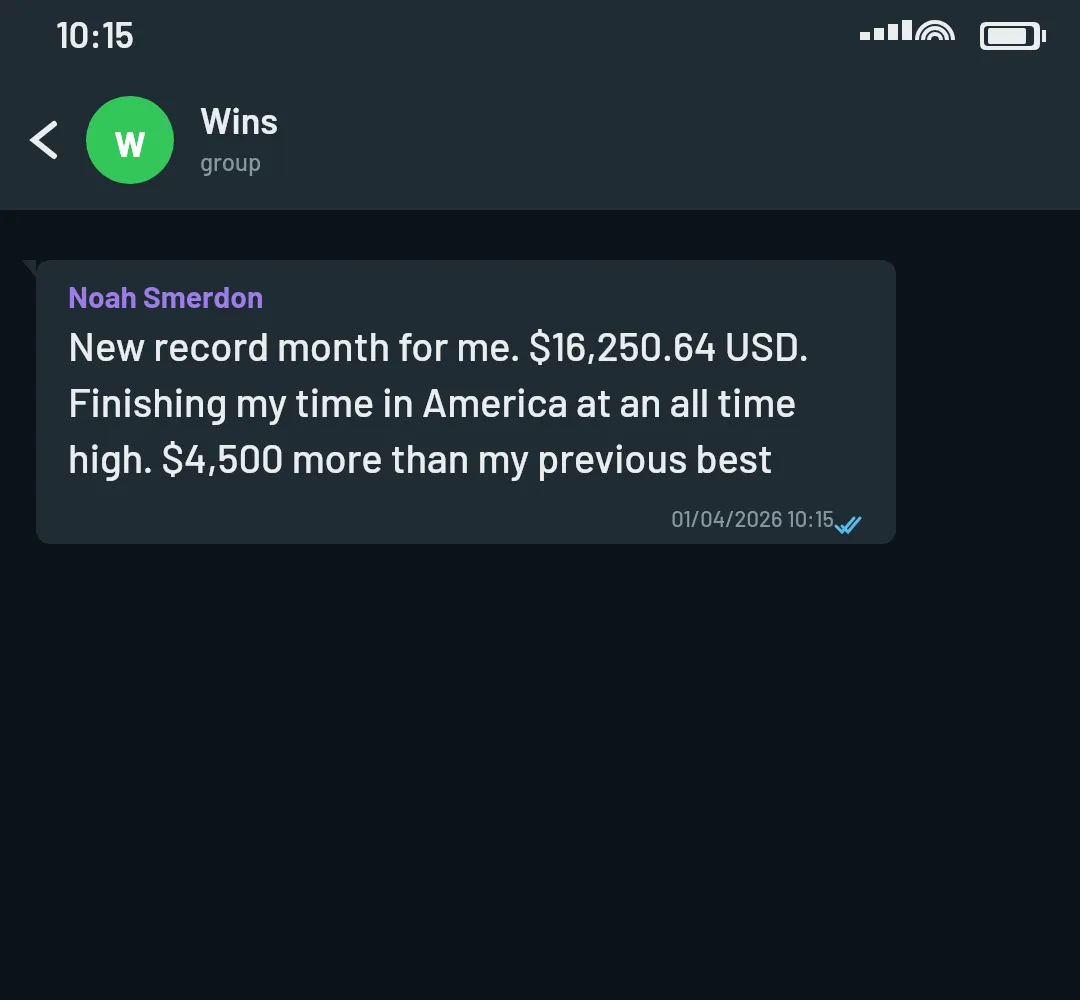
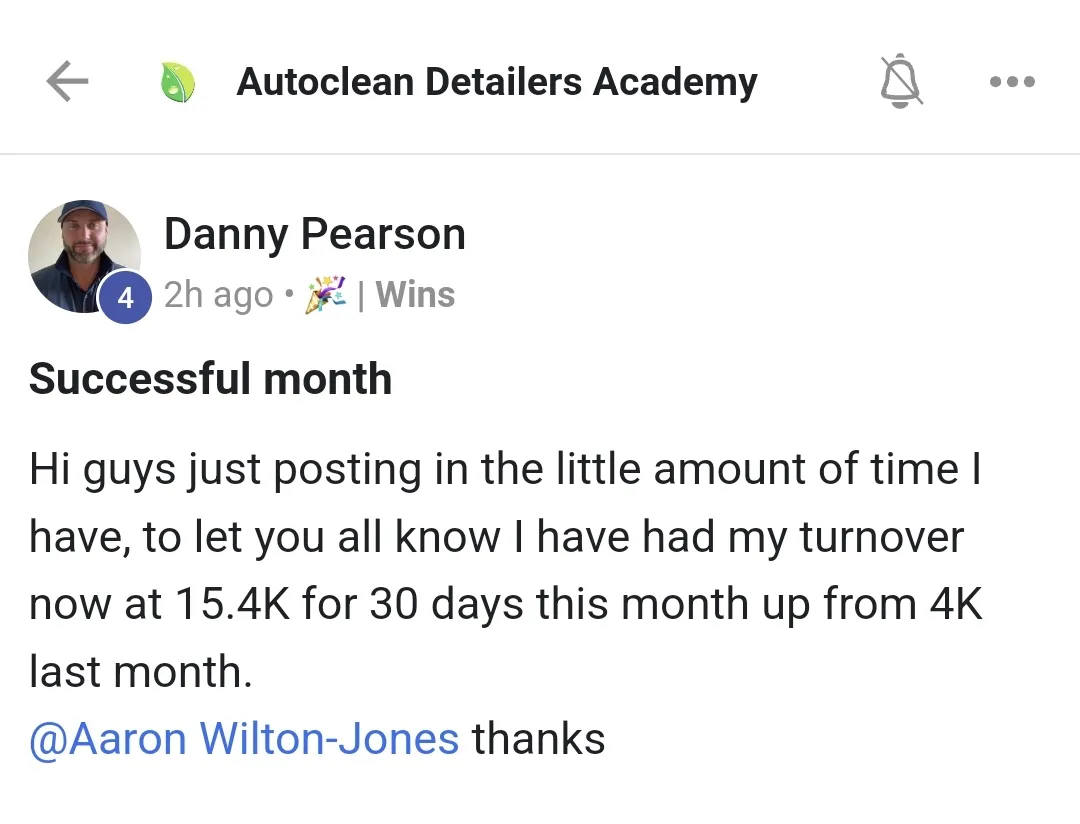
Noah Smerdon, one of our Academy members, hit $16,250.64 in a single month. Danny Pearson posted in the community that his turnover hit $15,400 for 30 days, up from $4,000 a previous month. These aren’t detailers who started with massive ad budgets. They built foundations first, then scaled.
Stop Waiting. Start Knocking.
You’ve got the skill. I already know that. If you’re reading this, you can detail a car. You can make an interior look new. You can polish paint. The detailing isn’t the problem.
Most detailers don’t have a detailing problem. They have a demand and follow-up problem.
The First 10 Playbook solves the demand problem without requiring a dollar in ad spend. Door knocking, Google review stacking, referral loops, and simple content. Four strategies. No cost. Immediate results.
Here’s your action plan for the next seven days:
- Set up or optimise your Google Business Profile. Today. Right now.
- Knock on 20 doors this week. Target neighbourhoods with nice cars. Lead with value.
- Post three before-and-after pieces of content. Facebook, Instagram, or both.
- Ask every single customer for a Google review AND a referral. Every one. No exceptions.
- Track everything. Doors knocked, bookings made, revenue earned, reviews collected.
If you follow the process, you’ll stop relying on luck. And once you’ve got those first 10 clients locked in, that’s when we can talk about pouring fuel on the fire.
If you want the full First 10 Playbook broken down step by step, plus the ad system, the CRM, the follow-up automations, and a coach who’s actually built detailing businesses from scratch, check out what we do inside the Autoclean Academy. You’ve got the skill. We build the system.
Frequently asked questions
How do I get car detailing clients with no money for advertising?
Based on my coaching experience, the fastest zero-cost methods are door knocking targeted neighbourhoods, asking every customer for Google reviews and referrals, and posting before-and-after content on social media. The First 10 Playbook combines all four into a structured system that builds momentum without any ad spend.
How many clients do I need to make $5,000 a month detailing?
Based on Academy member data, if your average order value is around $400 (mixing full details with some higher and lower ticket services), you need roughly 12-13 vehicles per month to hit $5,000. That's about three cars per week as a solo operator.
Does door knocking actually work for getting detailing customers in 2026?
Yes. In my coaching experience, door knocking works because car detailing is a mobile local service and every driveway with a dirty car is a potential client. It's not scalable long term, but it generates instant revenue with zero cost when you're starting out. I still teach it as a core strategy for new detailers.
How many Google reviews does a new detailing business need to rank locally?
There's no magic number, but based on Academy member data, detailers with around 18-20 five-star reviews are already appearing in the top three local search results in their areas. The key is consistency: ask after every single job and follow up with a message that includes a direct review link.
When should I start running paid ads for my detailing business?
In my coaching experience, ads work best after you've built a foundation of Google reviews, proven your pricing, and developed a follow-up process that actually converts leads into bookings. Depending on your market, that's usually after your first 10-15 paying clients. Ads are an accelerant, not a starting point.
What is a good average order value for a car detailing business?
Based on Academy member data, detailers inside the program are working toward an average order value between $400 and $500. That includes a mix of full details at the lower end and paint corrections or ceramic coatings at the higher end. Upselling premium services alongside core cleans is what drives that average up.
How do I ask detailing customers for referrals without being awkward?
Ask at the peak of satisfaction, right when they see the finished car. Something like: "Do you know anyone else who might want their car done? I've got availability this week." In my coaching experience, offering a small incentive like $20 off their next detail makes it even easier for them to follow through.