
Most detailers I talk to have the same problem. They picked their prices out of thin air, or worse, they copied some random guy on Instagram who also picked his prices out of thin air. The blind leading the blind. And now they’re stuck doing $200 jobs, working their ass off, wondering why they can’t quit their day job.
I’ve coached over 100 detailers across Australia, New Zealand, the US, Canada, and the UK. I’ve seen their pricing spreadsheets, their confused Canva menus with 12 packages, and their bank accounts that don’t match the hours they’re putting in. This article is the real data. No theory. No fluff. Just what actually works when it comes to setting prices that are profitable for you and valuable for the customer.
Let’s get into it.
Your Prices Should Start With a Floor, Not a Ceiling
The Pricing Floor Method means you calculate the absolute minimum you can charge before you lose money, then build upward from there. Most detailers skip this step entirely and wonder why they’re broke at the end of the month. Your floor is your costs plus your time. Everything above that is profit for the business.
Here’s how I explain it on coaching calls: the biggest expense in a car detailing business that’s solely operated by one person is that individual’s time. Your chemicals might cost you $10 to $15 per full detail. Fuel might be another $10. But your time? That’s where detailers get destroyed.
Let’s say you want to pay yourself $60 an hour. A full detail takes you four hours. That’s $240 in labour alone. Add $20 in costs for products and fuel. You now need to charge a minimum of $260 just to break even. Anything below that and you’re literally paying to clean someone else’s car.
That $260 is your pricing floor. Not your price. Your floor. The number you never go below. Your actual price should be well above that, because you need profit left over for the business after you’ve paid yourself.
I had a coaching client come to me recently who was just getting started. He’d used AI to generate a price list and it spat out $90 for a full detail on a small vehicle. Ninety dollars. For a full detail. I told him straight up, “that number will kill your business before it starts.” When we ran through his actual costs and time, his floor was closer to $250. We set his full detail price at $350 for a sedan, which sits right in the profitable range for his market.
What Real Detailers Actually Charge in 2026
Across the 100+ detailers I’ve worked with, the profitable ones charge between $300 and $450 for a full detail on a standard sedan. Ceramic coating jobs with paint correction start from $1,000 and go up to $2,000 or more depending on vehicle size and customer requirements. Interior deep cleans sit between $200 and $300.
Those aren’t aspirational numbers. Those are what’s actually being invoiced and collected by detailers running real businesses.
One detailer I work with charges $450 for a full detail and $1,000 to $2,000 for ceramic coatings. He was doing about 30 jobs a month, pulling in $7,000 to $8,000 in revenue. During summer months when ceramic coating demand picked up, he hit $10,000. Another member who focused purely on full details and interior cleans, no ceramic coatings at all, logged $10,740 for the month of January with just those two services.
Another coaching client charges $399 for his deluxe full detail package (interior, exterior, everything) and does six to eight cars per week. That’s his most popular service. He prices it $50 less per size category going down. Simple, clean, profitable.
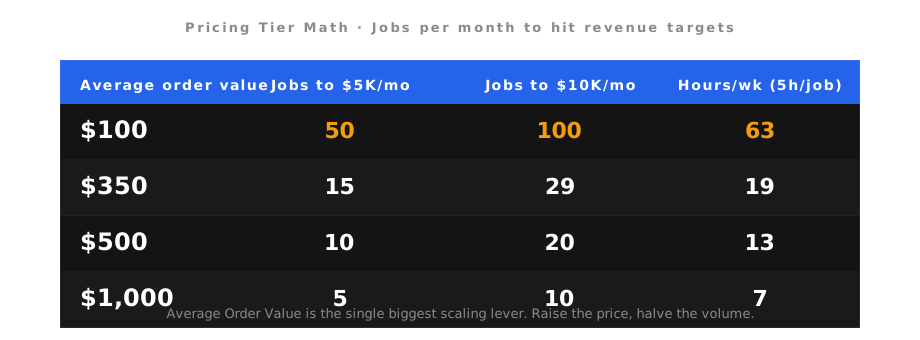
The math doesn’t lie. If you’re charging $200 per job, you need 50 jobs a month just to hit $10,000. That’s roughly 12 to 13 cars a week. At four hours per car, that’s 50+ hours of actual detailing per week before you factor in travel, quoting, follow-up, and admin. You’ve built yourself a brutal, underpaid job.
Bump that average to $400 and you only need 25 jobs. At $1,000 average (mixing in ceramic coatings), you need 10. Same revenue, completely different lifestyle.
The Five Steps to Set Your Price Right
The Pricing Floor Method isn’t guesswork. It’s a five-step process that gives you a defensible, profitable price anchored to your specific market. Here’s exactly how it works.
Step 1: Research Your Top 10 Local Competitors
Write down a list of the top 10 competitors in your area and then what they charge for each of their three or four core services. Go on their website. If they’ve got their prices listed publicly, great, grab them. In most cases you won’t find pricing anywhere and you’re going to actually have to call up and act like a customer to find out what they charge. This is a critical part of the process. You’re not copying their pricing. You’re understanding what the market rate is for particular car detailing services in your area.
Those top 10 detailers have probably been around for a while. They’ve established a firm price in the market. They know what customers are willing to pay. Use that data.
Step 2: Calculate Your Pricing Floor
Add up your direct costs (chemicals, fuel, wear and tear on equipment) and your indirect costs (insurance, software, marketing). Then decide on a minimum hourly rate you want to pay yourself. I try to aim for an hourly rate of $60 to $100 per hour if I’m going to go and detail a vehicle.
Multiply your hourly rate by how long the job takes. Add your costs. That’s your floor. Write it down. Tattoo it on your arm if you have to. You never charge below this number.
Step 3: Price in the Upper Range
Now you’ve got your competitor data and your floor. If the bottom of your top 10 charges $250 for a full detail and the top charges $400, I’d be pricing my service anywhere from $350 to $400 in that upper range of the market. Same goes for all services. Price them in the upper range.
It’s already proven to be successful. Customers are willing to pay those prices. These businesses have probably been around for a long time. You’re not going to be too expensive. You’re just coming in at a very good position.
Here’s something most new detailers don’t realize: cheap prices attract cheap quality clients. I remember one time I discounted a customer about 50%. I was doing this full detail for like $75 and it was taking me three to four hours. The customer came out and started nitpicking every little thing I’d missed. A speck of sand here, a little bit of hair there. Ended up getting a negative review even though I gave them a discount. I realized from that moment forward I don’t want these cheap customers anymore.
Step 4: Keep Your Service List Streamlined
Two to three core services. That’s it. Not 12 packages. Not a Canva menu that looks like a restaurant wine list. One detailer I was coaching told me he’d looked at a competitor who had “about 12 packages that start at $50 and go down to a thousand dollars” and when he actually looked closely, the competitor was offering the same thing but just with different wording. That’s decision fatigue in action.
Here’s what I recommend as your core service structure. This is 10 years of refining services and prices.
Core Service 1: Full Detail (interior deep clean, full exterior wash, sealant protection). Price range: $300 to $450 depending on your market and vehicle size.
Core Service 2: Interior Deep Clean (standalone interior service). Price range: $200 to $300.
Core Service 3: Paint Enhancement + Ceramic Coating (for when you’re ready to offer this). Price range: $1,000 and up.
That’s it. Three core services. You recommend the best one based on what the customer needs. You don’t send them a price list and let them choose.
Step 5: Upsell and Downsell on the Day
This is where the real revenue lift happens. Say you’ve booked someone in for an interior deep clean at $250. You get there, look at the exterior, and say, “Hey look, the wheels could really do with a bit of a detail. Why don’t we just do the exterior for you as well? Knock it out today. That’s only an extra $80.” And you frame it like this: “Rather than paying $400 which is our normal full detail price, it’s only an extra $80 for you today.”
Boom. You just turned a $250 job into a $330 job with one sentence.
The reverse works too. If someone balks at the $400 full detail, downsell to an express service at $300. Then when you’re there on the day and the car’s filthy, you can say, “Honestly, you’re going to benefit more if we do a full detail. Rather than $400, we’ll just do it for $380 today.” You upsell right back into the full service.
The Hourly Rate Reality Check
Forget what you charge per job for a second. What matters is your effective hourly rate after costs. That’s the number that determines whether this is a real business or an expensive hobby.
One of our members logged $11,713.25 in revenue from 83 hours and 20 minutes of actual work. That’s over $140 per hour effective rate. Another member tracked $10,648.25 from 78 hours and 50 minutes. That’s about $135 per hour. A third logged $10,348.25 from 73 hours and 20 minutes, just over $141 per hour.
These aren’t shop owners with staff. These are detailers doing the work themselves, pricing correctly, and tracking their numbers.
Contrast that with the detailer doing $200 jobs that take five hours. That’s $40 per hour gross, before costs. After chemicals, fuel, and drive time, you’re looking at maybe $30 per hour. If you’re spending five hours on a $200 detail, you’re losing money. I don’t care how clean the car looks.
The difference isn’t skill. It’s pricing structure.
You Are the Expert, So Act Like One
The biggest pricing mistake isn’t the number itself. It’s how you present it. Most detailers send a price list and let the customer decide. The moment you do that, you’ve lost control.
Think about it this way. When you go to the doctor, the doctor analyzes the problem, diagnoses the problem, then prescribes the solution. The doctor doesn’t hand you a menu of medications and say “pick one.” You are the expert. You make the recommendation.
So when a customer messages you and asks “what’s your price?”, don’t just fire back a number. Ask questions first. What’s the vehicle? What’s the reason for getting it detailed? When was the last time it had a professional clean? Has it ever had paint protection? These questions do two things: they give you data to recommend the right service, and they let you figure out the customer’s budget before you ever mention a price.
Once you’ve done your detective work, you prescribe. “Based on what you’ve told me, what I recommend is our full detail. It’s our most popular service. We’ll clean the entire interior and exterior, bring it back to that showroom feel, and add a three to six month sealant to protect the paintwork. That service is $397. How does that sound?”
You’re not asking them what they want. You’re telling them what they need. That’s how the best detailers in our community consistently close at higher prices.
Why Undercutting Kills Your Business and the Industry
I see this constantly. New detailers think, “I’ll just charge less than the competition to get my foot in the door.” It feels logical. It’s also the fastest way to burn out and go broke.
Undercutting the market is a no-no. I do not recommend that at all. You’re not only hurting your business, you’re hurting the industry as a whole. When you charge $50 for a detail, you’re training customers in your area to expect $50 details. Every other detailer now has to fight against that anchor price you’ve set.
One detailer I spoke with on a strategy call understood this perfectly. He’d come from running a niche breeding business, where the exact same thing happened. People bred low-quality animals and sold them for $50 instead of $100, which tanked the entire market. He told me, “that doesn’t do anything for the industry, just harms it.” Same principle applies to detailing.
If you’re in a rural area where there’s not much awareness around car detailing, you might start slightly below the upper range while you build awareness. But you still don’t go below your pricing floor. Ever.
Real Revenue Targets Using the Pricing Floor Method
Let me show you what’s possible when you price correctly.
One of our members hit a new record month of $16,250.64 USD. Another member looked at the month ahead and had $10,000 in ceramic coatings already booked over just four jobs. Four jobs. Ten grand. That’s the power of high-ticket services priced correctly.
Another member had good potential to reach $15,000 but estimated he’d end the month at $12,000 to $13,000. And one member hit $21,472.76 in a single month from 176 hours and 30 minutes of work. That’s over $121 per hour, and he was pushing serious volume.
None of these guys are using magic. They followed the Pricing Floor Method, structured their services around two to three core offers, and stopped saying yes to low-paying work.
Your Market Matters, But Not as Much as You Think
I coach detailers in big cities like Sydney and small towns across New Zealand. The pricing principles don’t change. The numbers shift slightly, but the method is identical.
A detailer in a major metro might charge $450 for a full detail while someone in a smaller regional area might sit at $350. The floor calculation works the same way in both markets. Your costs are your costs. Your time is your time.
What does change is volume. In a big city, there’s heaps of demand. In a small town, you might need to create awareness first. But in both cases, pricing in the upper range of your local market is the move. Competition actually proves demand. If there are 10 detailers in your area all charging $300 to $400, that tells you customers are willing to pay $300 to $400. You don’t need to come in at $150 to compete.
Stop Guessing, Start Calculating
If you take one thing from this article, it’s this: your price should never be a feeling. It should be a calculation. Know your floor. Research your market. Price in the upper range. Keep it simple with two to three core services. Recommend the service, don’t let the customer choose from a menu. Upsell and downsell on the day.
The Pricing Floor Method isn’t complicated. Most detailers just skip the work. They don’t want to call 10 competitors. They don’t want to sit down and calculate their costs. They don’t want to have a hard conversation with themselves about what their time is actually worth.
Do the work. Set the price. Stop leaving money on the table.
If you want help building this out for your specific market, that’s exactly what we do inside the Autoclean Academy. We help detailers get to $10,000 to $30,000 per month using the 5-Gear Growth System. Pricing is one gear. But if even one gear isn’t turning, everything feels hard.
Frequently asked questions
How much should I charge for a full car detail in 2026?
Based on Academy member data, profitable full details on a standard sedan range from $300 to $450 depending on your market. Use the Pricing Floor Method to calculate your minimum, then price in the upper range of your top 10 local competitors. Never charge below your floor.
What is a good hourly rate for a car detailer?
In my coaching experience, the detailers building real businesses aim for $60 to $100 per hour as a minimum when calculating their pricing floor. Several Academy members consistently track effective rates above $130 per hour once they price their services correctly and cut low-ticket jobs.
How much should I charge for a ceramic coating job?
Depending on your market and the vehicle size, ceramic coating with paint correction starts from $1,000 and goes up to $2,000 or more. One Academy member had $10,000 in ceramic coatings booked across just four jobs. This is the highest-margin service in most detailing businesses.
Should I put my car detailing prices on my website?
Based on Academy member data, listing exact prices on your website gives away control. Instead, show 'from' prices or price ranges for your core services. The real selling happens when you ask the customer questions, diagnose their vehicle's needs, and recommend the right service like an expert.
How many car detailing services should I offer?
In my coaching experience, two to three core services is the sweet spot. A full detail, an interior deep clean, and a paint correction with ceramic coating. Too many options cause decision fatigue and confuse customers. You upsell and downsell from those core services on the day.
Is it a good idea to undercut other detailers on price?
No, depending on your market positioning. Cheap prices attract cheap customers who nitpick your work and leave bad reviews. In my coaching experience, undercutting also damages the market rate for every detailer in your area. Price in the upper range of your local competitors and compete on value and service quality instead.
How do I find out what other detailers charge in my area?
Research your top 10 local competitors. Check their websites for prices. In most cases you won't find pricing listed publicly, so you'll need to call and act like a customer. This gives you the market rate for your area, which is the foundation of the Pricing Floor Method.
Can I make $10,000 a month as a solo car detailer?
Based on Academy member data, multiple solo detailers hit $10,000 or more per month. One logged $10,740 with just full details and interior cleans. The key is pricing correctly so you don't need brutal volume. At a $400 average job, you need 25 jobs a month, which is very doable.