

Most detailers I work with are charging less than they should. Not because they don’t know their craft. Because nobody ever sat them down and showed them the actual math behind what a job needs to cost for the business to survive, let alone grow.
If you’ve ever quoted a price and immediately felt that knot in your stomach, like you were asking for too much, this one’s for you. That feeling? It’s not intuition. It’s a lack of structure. And today we’re going to fix it with something I call the Pricing Floor Method.
Let’s get into it.
What Is the Pricing Floor Method?
The Pricing Floor Method is a framework that calculates the absolute minimum you should charge per job based on your real costs, your time, and your income goal. It removes emotion from pricing and replaces it with a number you can defend. If a job falls below your floor, you don’t take it. Full stop.
Here’s what I tell every detailer I work with: pricing isn’t a number, it’s actually a system. The dollar figure is a very small part of what you actually have to offer. Most of the heavy lifting happens before you ever reveal a price, in how you position yourself, how you structure your services, and how you present the value. But none of that matters if your base number is wrong.
The Pricing Floor Method gives you that base number. Everything else, your upsells, your premium packages, your ceramic coating add-ons, gets built on top of it. Without it, you’re guessing. And guessing is how you end up doing $50 detail jobs that take four hours and wondering why you can’t pay rent.
Why Most Detailers Undercharge (And Don’t Even Know It)
The biggest objection I hear when it comes to raising prices is “I’m just going to lose all my clients” or “people just won’t book me anymore because my prices are too high.” That’s just a misbelief. There’s always someone willing to pay your prices. The real problem is you haven’t done the math to know what your prices should actually be.
Here’s what I see constantly. A detailer charges $150 for a full detail because that’s what the guy down the road charges. They spend 4 to 5 hours on the job. They drive 30 minutes each way. They use $20 to $30 in product. After fuel, wear and tear, and product costs, they’re netting maybe $15 to $20 an hour. Some of these guys could earn more stacking shelves at a supermarket.
And the worst part? They’re not even tracking it. You can’t control what you don’t track.
I had one member come to me on his onboarding call and say his biggest challenge was “correct costings.” He’d spent days trying to figure out what to charge. He looked at competitors in his city, and it confused him even more, because one guy had 12 packages starting at $50, all basically the same thing with different wording. That’s the blind leading the blind.
Another detailer I spoke with had been quoting ranges to potential customers, saying things like “worst case scenario it’ll be this much.” Think about what that communicates. You’re implying your own price is a bad thing. We want the perception to be that the price is affordable, it’s valuable, it’s premium. It’s set at this rate for a reason.
Stop apologizing for your prices. Start calculating them.
How to Calculate Your Pricing Floor in 4 Steps
The Pricing Floor Method is a simple calculation. It takes about 20 minutes. But it will change the way you quote every single job from here on out. Here’s how it works.
Step 1: Define Your Monthly Income Goal
Start with the end in mind. What do you actually need to earn each month? Not revenue. Take-home income. One member I worked with said he’d be laughing if he could kick around a thousand a week. That’s roughly $4,000 a month as a floor. Another detailer I coach was targeting $10,000 a month so he could quit his day job. Your number is your number. Write it down.
If you don’t have a number, you don’t have a business. You have a hobby.
Step 2: Calculate Your True Cost Per Job
This is where most detailers fall apart. They think their cost is just the product they spray. Wrong. Your true cost per job includes:
- Product and consumables (compounds, coatings, towels, clay bars, dressings)
- Fuel and travel time (if you’re mobile, this is massive)
- Equipment depreciation (your polisher, your pressure washer, your extraction unit, none of it lasts forever)
- Insurance, registration, software, subscriptions
- Your time (the single biggest cost most detailers ignore)
Add all your fixed monthly costs up. Divide by the number of jobs you can realistically do in a month. That’s your overhead per job.
For a mobile detailer doing around 3 to 4 jobs per week, your fixed monthly overhead per job can easily sit between $30 and $60 depending on your market. Add product cost per job on top. Now you have your true cost per job.
Step 3: Set Your Hourly Minimum
Decide what your time is worth. Not what you’d like it to be worth in a dream world. What is the minimum you’ll accept per hour of actual working time, including travel, setup, teardown, and the detail itself?
Here’s a real data point from one of our Academy members. They tracked $11,713.25 in revenue across 83 hours and 20 minutes of work in a single month. That’s an effective rate of roughly $140 per hour. That’s a detailer who has their pricing dialed in.
Now compare that to another member who tracked $10,648.25 across 78 hours and 50 minutes. That’s about $135 per hour. Still strong.
These aren’t unicorn numbers. These are detailers who calculated their floor, stopped taking jobs below it, and built their service mix around high-value work.
If you’re doing full details and your effective hourly rate is below $60 to $80, something in your pricing is broken.
Step 4: Run the Floor Equation
Here’s the equation:
Pricing Floor per job = (Monthly income goal ÷ realistic jobs per month) + true cost per job
Let’s say your income goal is $5,000 a month. You can realistically do 14 jobs per month (about 3 to 4 per week). Your true cost per job is $45.
$5,000 ÷ 14 = $357 per job in income needed. Add $45 in costs. Your Pricing Floor is $402 per job.
That means if you’re charging $300 for a full detail, you literally cannot hit your income goal at your current volume. You either need to raise prices, do more jobs (and burn out), or cut your income target. Two of those three options suck.
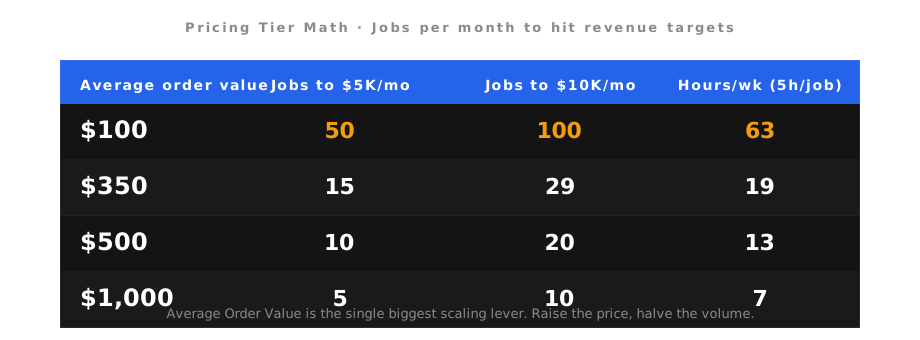
Now let’s run it for a $10,000 month. Same 14 jobs. Same $45 cost.
$10,000 ÷ 14 = $714 per job in income needed. Add $45. Your Pricing Floor is $759 per job.
Suddenly you see why ceramic coatings and paint correction packages matter. A $400 full detail will never get you to $10,000 a month at 14 jobs. But a mix of $400 full details and $1,000 to $1,500 ceramic coating packages? Now the math works.
This is what I mean when I say pricing isn’t a number, it’s actually a system.
The Service Mix: How Your Floor Shapes What You Offer
Once you know your Pricing Floor, you can structure your services around it. This is where the real leverage sits. Not in discounting. Not in adding 12 packages with different names. In building a service mix that keeps every single job above your floor.
I coach detailers to focus on six core services, but honestly, most members only need to nail two or three to start. Here’s the structure I walk through on every onboarding call:
- Interior deep clean (typically $200 to $300 for a sedan)
- Full detail with up to 6-month sealant (typically $350 to $400 for a sedan)
- Paint enhancement or correction with ceramic coating (typically $800 and up)

Service one is your entry point. Service two is your bread and butter, the most popular service. Service three is where you build real margin and start flipping the monthly math in your favour.
I always tell new members: focus on service two first. Get that dialed in. Get your reviews. Get your content. Then start learning paint correction and ceramics, because that’s where you can charge $1,500 for one job and make almost as much as doing multiple full details.
The key is that every core service sits above your Pricing Floor. And then you use upsells and downsells strategically.
Upsells and Downsells: Protecting Your Floor While Closing More Jobs
Upsells and downsells are not about tricking people. They’re about guiding the customer to the right service for their situation while making sure you never drop below your floor.
Here’s how I teach it. You always recommend the core service first. Full detail, $397 (or whatever your number is). If the customer hesitates on price, you downsell to an express option, maybe $297. But that express option must still be above your Pricing Floor. If it’s not, you don’t offer it.
The best upsells happen when you’re there with the customer on the day. You arrive for an interior deep clean, you look at the exterior and say, “Hey look, the wheels could really do with a bit of a detail. Why don’t we just do the exterior for you as well? Knock it out today. That’s only an extra 80 bucks. And rather than paying $400 which is our normal full detail price, it’s only an extra 80 for you today.”
That’s framing. That’s positioning. And it works because you’ve already anchored the higher price.
One more thing. The downsell is never something you promote on your website or in your ads. It’s a tool you use in conversation when someone can’t stretch to the full service price. It exists to save the booking, not to become your main offering.
How to Reveal the Price Without Flinching
95% of pricing happens before you ever say a number. That’s not me being theoretical. That’s boots on the ground, thousands of quotes, across multiple detailing businesses I’ve built.
When you reveal the price, never use language that frames it as a negative. One of our members said he’d been telling potential customers “worst case scenario, it’ll be this much.” That’s pricing suicide. You’re training the customer to think your price is something to be afraid of.
Instead, present the price as a fact. “For a full detail on your sedan, including interior, exterior, and six months of paint protection, the investment is $397. We can get you booked in for this Thursday.”
Notice the structure: describe what they get, state the price, give them the next step. No pause. No apology. No “is that okay?” You’re the expert. You set the rate. They decide if they want the service.
And if they push back? You don’t drop your price. You drop the scope. That’s the downsell. “No worries at all. What we could do is the express full detail, doesn’t include the sealant protection, and we’ll do that for $297 today.”
You’ve protected your floor. You’ve kept the customer. And you haven’t trained them to think your pricing is negotiable.
Real Numbers: What Happens When Detailers Set a Floor and Stick to It
I’m not going to sit here and tell you this is easy. Charging more feels uncomfortable at first. But the results speak for themselves.
One Academy member hit $10,740 in a single month doing just full details and interior cleans. No ceramic coatings. No paint correction. Just nailing the core service, priced correctly, with enough volume to stack up.
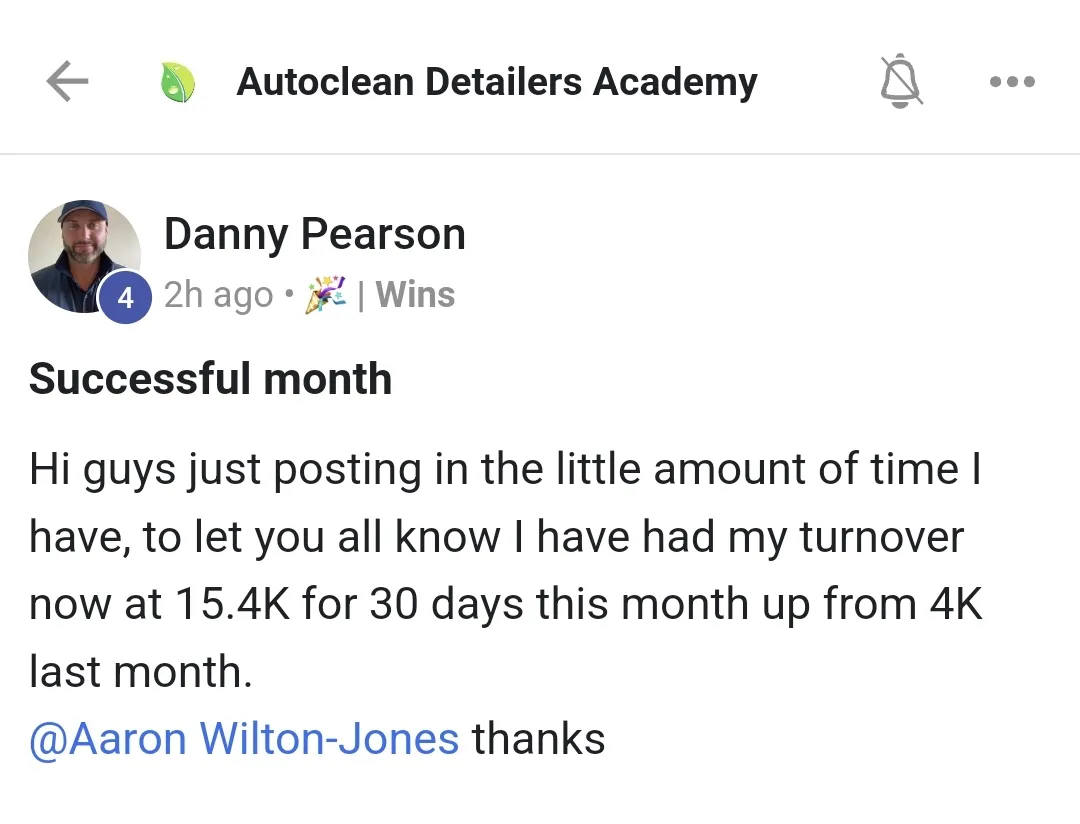
Another member, Danny Pearson, posted in our community that he’d hit $15,400 in 30 days, up from $4,000 the previous month. That kind of jump doesn’t come from working four times harder. It comes from pricing correctly, targeting the right customers, and following a system.
And then there’s Noah Smerdon, who hit a record month of $16,250.64. Noah hit this in his final month in the US before relocating to Australia. He had a Pricing Floor, a service structure, and he executed.

These aren’t guys with fancy shops and 10 employees. These are solo detailers, many of them mobile, who stopped guessing and started calculating.
The “But My Market Is Different” Objection
I hear this every week. “Aaron, that works in your area, but my market is different. People won’t pay those prices here.”
Maybe. But usually, when I dig into it, the detailer hasn’t actually tested higher prices. They’ve assumed. They’ve looked at what competitors charge and matched it. They’ve let fear set the price instead of math.
Here’s the thing: even in a “cheap” market, your Pricing Floor doesn’t change. Your costs are your costs. Your time is your time. If the market genuinely won’t support your floor, then you have two choices: change your service mix (add higher-value services like ceramic coatings) or change your market (target a wealthier suburb, a different customer segment, commercial clients).
What you don’t do is lower your floor. That’s how you end up doing $50 jobs and hating your life.
I’ve worked with detailers across Australia, New Zealand, the US, Canada, and the UK. The specific dollar amounts vary by market. But the framework is the same everywhere. Calculate the floor. Structure your services above it. Don’t flinch when you quote.
Common Pricing Mistakes That Kill Detailing Businesses
Let me run through the ones I see constantly.
Mistake 1: Using AI or competitor research to set prices. One member told me he used AI to put together a pricing guide and it came back with $90 for a full detail on a small vehicle. Ninety bucks. For a full detail. That’s not a business, that’s charity. Competitor research gives you a range, but it doesn’t account for your costs, your goals, or your floor.
Mistake 2: Having 12 packages that all look the same. I see this with established detailers too. They’ve got so many packages the customer doesn’t know what to pick, and neither does the detailer. Keep it to three or four core services. That’s it.
Mistake 3: Putting prices on brochures, flyers, or your website in full detail. I don’t recommend adding your prices to a brochure because prices will change and also prices just put up a barrier. Whenever a potential customer sees a price on a flyer, they typically just go “I’ll do it later.” Keep prices for the conversation, where you can frame and defend them.
Mistake 4: Quoting ranges instead of fixed prices. When you say “it’ll be between $300 and $500,” the customer hears $300. Every time. Quote a specific number for a specific service on a specific vehicle. If you need to adjust based on vehicle size or condition, inspect first, then quote.
Mistake 5: Never raising prices. Your costs go up every year. Products, fuel, insurance, everything. If you haven’t raised your prices in the last 12 months, you’ve given yourself a pay cut. Once you’ve got about 10 reviews on your Google Business Profile and your social media is starting to build, it’s time to move prices up.
How to Implement the Pricing Floor Method This Week
Don’t overthink this. Here’s your action plan:
- Write down your monthly income goal. The real number. What you need to live the life you want.
- List every monthly business expense. Product, fuel, insurance, subscriptions, equipment wear. All of it.
- Divide total monthly expenses by realistic jobs per month. That’s your overhead per job.
- Divide your income goal by realistic jobs per month. That’s your income requirement per job.
- Add those two numbers. That’s your Pricing Floor.
- Compare your current prices to your floor. If any service is below the floor, raise it or remove it.
- Restructure your services so every core offering sits above the floor. Use the three-service structure: interior clean, full detail, paint correction and ceramic coating.
If you follow the process, you’ll stop relying on luck. You’ll know exactly what to charge and exactly why. And when a customer pushes back, you won’t flinch, because you’ve got the math behind you.
This is the Pricing Floor Method. It’s not theory. It’s the same system I use with every detailer I coach. And it works.
Frequently asked questions
What is a good price to charge for a full car detail in 2026?
Based on Academy member data, a full detail on a sedan (interior, exterior, and up to 6-month sealant) typically ranges from $350 to $400 depending on your market. Your specific price should be calculated using the Pricing Floor Method so it covers your costs and income goal, not copied from a competitor.
How do I raise my detailing prices without losing customers?
In my coaching experience, the fear of losing customers from a price increase is almost always bigger than the reality. Focus on building social proof first (aim for at least 10 Google reviews), then raise prices and frame the value, not the cost. Most detailers find they lose a few price shoppers and gain better clients who respect premium work.
How many car detailing jobs per month do I need to make $10,000?
It depends entirely on your average order value. At $350 per full detail, you'd need roughly 29 jobs per month. At $700 average (mixing full details with ceramic coatings), you'd need about 15 jobs. The Pricing Floor Method helps you pick the service mix that hits your goal without burning out on volume.
Should I put my detailing prices on my website?
Based on what I teach in the Academy, I recommend displaying a 'from' price for your core services but not a full price breakdown. Detailed pricing creates a barrier and lets customers self-disqualify before you've had a chance to explain the value. Save the specific quote for the phone call or in-person conversation.
How do I calculate the real cost of a mobile detailing job?
In my coaching experience, most mobile detailers undercount costs by 30% or more. Your true cost per job includes product and consumables, fuel and travel time, equipment depreciation, insurance, and software or subscriptions. Add all fixed monthly costs, divide by jobs per month, and add per-job product costs on top.
Is it better to offer a few detailing packages or many?
Based on Academy member data, three to four core services outperform a long menu every time. Too many packages confuse the customer and confuse you. Start with an interior deep clean, a full detail with sealant, and a paint correction with ceramic coating. Use upsells and downsells in conversation, not on your price list.
What should I do if a customer says my detailing price is too expensive?
Don't drop your price. Drop the scope. Offer a downsell that's still above your Pricing Floor, like an express detail without protection. In my coaching experience, this saves the booking while training the customer that your pricing is firm. Never frame your own price as a 'worst case scenario' or something negative.
How often should I raise my car detailing prices?
Depending on your market and growth stage, I recommend reviewing prices every 3 to 6 months. At minimum, raise prices once a year to keep up with product, fuel, and insurance cost increases. If you haven't raised prices in over 12 months, you've effectively given yourself a pay cut.