

Most detailers sitting at $3K a month think the problem is they need more customers. It’s not. The problem is usually a combination of underpriced services, zero follow-up, and no system pulling it all together. I’ve watched this play out dozens of times inside the Academy. And I’ve watched what happens when someone actually installs a system and commits to the process for six months.
This is the anatomy of that arc. Not theory. Real numbers from real coaching calls, real member results, and the exact gears that need to turn to make it happen.
The Starting Point: Stuck at $3K With No Clear Path Forward
Most detailers who come to me at $3K per month are not bad at detailing. They can do the work. The real problem is they don’t have a clear client acquisition system that brings in consistent inquiries every single week. They’re relying on word of mouth, maybe a few Instagram posts, and hoping the phone rings. That’s not a business. That’s a gamble.
On almost every onboarding call I run, I hear the same thing. A detailer who has been running their business for a while, maybe doing 15 or 16 Google reviews, getting some inconsistent work, but can’t tell me what they did in revenue last month off the top of their head. When I ask “what did last month look like?” there’s a long pause. That pause tells me everything.
One detailer I onboarded recently put it simply: everything was slowing right down, then it picked up again, but he didn’t know what the week after next was going to look like. Just inconsistency. Not consistent enough. That’s the pattern. The skill is there. The demand and follow-up system is not.
The other thing I see constantly is detailers doing 40 jobs a month but only bringing in $6K to $8K. That’s an average of $150 to $200 per job. You’re grinding yourself into the ground at that rate. It’s not a volume problem. It’s a pricing and service structure problem.
The Framework: How the 5-Gear Growth System Creates the Path
The 5-Gear Growth System is the operating model behind every Academy member who breaks past $10K per month. It covers five gears: Lead Generation, Lead Nurture, Sales, Delivery and Retention, and Systems and Operations. If even one gear isn’t turning, everything feels hard. Fix the gears, the business runs.
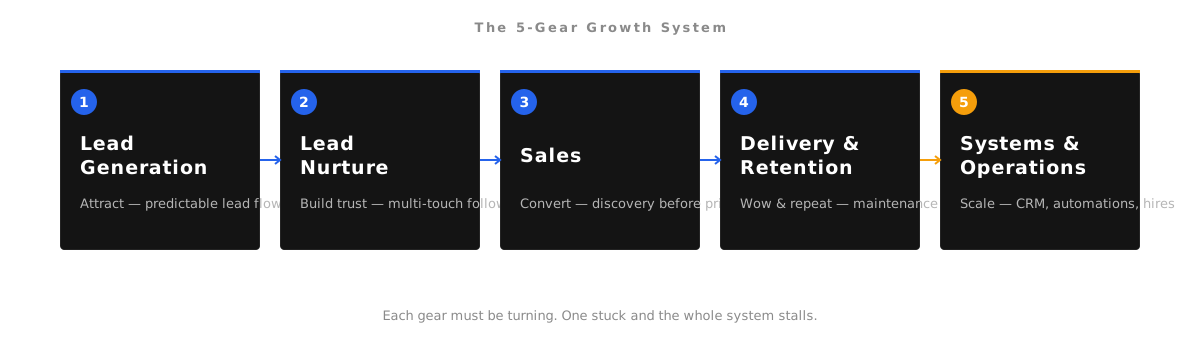
Here’s the thing most detailers miss. They think they have a marketing problem when actually they have a sales problem. Or they think they need more leads when what they actually need is to follow up with the leads they already have. The 5-Gear system forces you to look at each part honestly and fix the weakest link first.
On a coaching call I did recently, I walked a new member through this exact thinking. I told him: “There’s two parts to client acquisition. There’s the marketing, which creates the awareness and brings people into our world. And then there’s sales, which then converts that interest. Those people that have raised their hand, interested in our services, converts them into customers.” Most detailers only focus on one side. Usually marketing. And they wonder why leads come in but never convert.
The six-month arc from $3K to $10K is not about doing one big thing. It’s about installing each gear in the right order, at the right time, based on where you’re actually at.
Month 1: Foundation, Pricing, and the First Wins
The first thing we do on every onboarding call is focus on things that are going to give us results immediately. Things that are relevant to where you’re at right now. I don’t dump six months of tasks on someone in one call. They’ll forget it all as soon as we hang up.
For a detailer at $3K per month, the highest-impact move in month one is almost always restructuring services and pricing. I tell every new member: “There’s no point of packaging services together if they’re not actually exactly what the customer wants.” A lot of detailers copy someone else’s service menu, who was copying someone else, who just guessed. The result is a confusing list of features the customer doesn’t care about.
I’ve refined a service structure over 13 years in this industry. It’s based on evidence and data, not guesswork. And the core principle is simple: sell benefits, not features. A customer doesn’t care that you use a specific brand of ceramic coating. They care that their paint will be protected from the environment and look incredible for years.
The pricing math is brutal at low ticket prices. If you’re charging $150 per full detail, you need 67 jobs to hit $10K. If you’re charging $500, you need 20. If you’re doing ceramic coatings at $1,000, you need 10. It’s much easier to find 10 people willing to pay $1,000 than it is to find 100 people willing to pay $100.
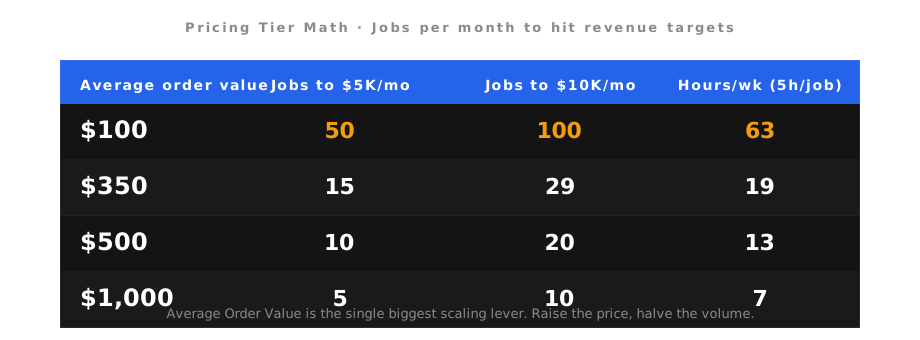
I aim for a minimum of $100 per hour when you’re working on your own. If you’re working for less than that, your profit margins are being eaten alive by products, fuel, software, and time. You need to be above $100 per hour as a solo operator.
Month one is also about setting up the four key marketing assets: Google Business Profile, Instagram profile, Facebook page, and a landing page. These need to be highly optimized because this is how people are interacting with us, building trust with us, and seeing what we actually deliver.
Month 2-3: Turning On the Lead Engine
Once the foundation is set, we turn on paid traffic. Specifically, Meta ads. This is the fastest way to go from hoping the phone rings to having a predictable flow of inquiries every single week.
I set up a full detail campaign first for most members. The ad directs traffic to an instant form on Meta because it’s the lowest friction. If we direct them to a landing page first, it creates another barrier which decreases the number of leads we get. We want to get as many leads into the business as possible and then qualify from there.
But here’s where most detailers drop the ball. They start getting leads and then don’t follow up. I’m not exaggerating when I say this: follow up, follow up, follow up. Speed to lead is everything. When a new lead comes in, you need to be calling them as fast as possible. Every hour you wait, the chance of booking that job drops off a cliff.
One of our members described his process like this: as soon as a lead comes in, he evaluates the car, does a quick background check on the vehicle to have better information, and then calls them straight away. He doesn’t wait. He doesn’t send a text first. He calls. And on that call, he always goes straight into coating or protection because he knows the customer will value it even if they didn’t ask for it specifically.
The CRM is critical here. Every lead gets tracked. Every follow-up gets scheduled. You can’t control what you don’t track. If someone doesn’t answer, they go into a follow-up sequence. Not being too pushy, just pushy enough so you’re in the back of their mind.
Month 3-4: The Sales Process That Actually Converts
Leads mean nothing if you can’t close them. This is where Gear 3, the sales process, makes or breaks the whole thing.
For detailers doing high-ticket work like ceramic coatings, in-person consultations are a weapon. One member I work with started going to see potential customers face to face whenever he could. He’d look at the car in person, point out what was actually needed, and recommend the right service. You get to see the car yourself, give them a precise quote, and build trust through a handshake. That member went from struggling to break $10K to hitting $30K in a single month within a few months of working together.
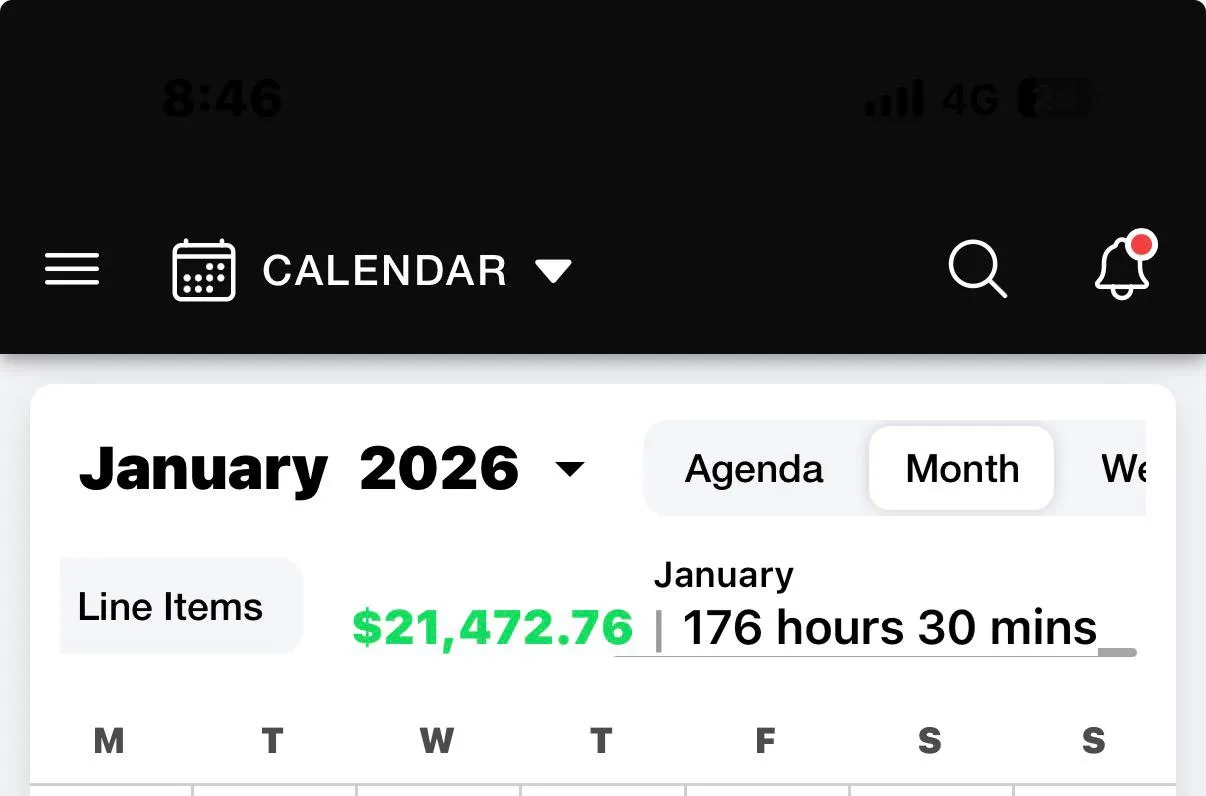
Leroy Pertab is a good example of this in action. When he started working with me, he was doing around $5K to $7K a month. He couldn’t break through $10K. Within about a month of implementing the system, he had his record month. His average order value was over a thousand dollars. Most of the guys I work with start at average order values of around $100 to $200. The difference in profit margins is massive. Doing a $200 job might take you 2 hours. Doing a $1,000 job might take you 6 hours. The hourly rate on the bigger job is significantly better.
The close rate on Meta ad leads is different from the close rate on referral leads, which is different from Google leads. You can’t treat them all the same. A referral already trusts you. A cold Meta lead needs more touch points before they commit. That’s why the nurture system matters so much.
Month 4-5: Compounding Results and Hitting the First $10K Month
This is where things start to compound. You’ve got the pricing right. You’ve got leads coming in consistently. You’ve got a follow-up system that doesn’t let anyone fall through the cracks. And you’ve gotten better at sales conversations.
The pattern I see over and over is not a clean straight line to $10K. It’s more like this: you might get $4,000 one month, then $3,500, then $5,000, then back to $4,000, then $7,000, then $10,000, then maybe $9,000. There are ups and downs. But the overall trend is up. And the fluctuations get smaller as the systems get tighter.
I told one new member on his onboarding call: “We want to get above $10K months. You’ve got pressure with a baby coming, you’ve got all the elements to just grind this out and get to over $10K per month with the right systems.” And that’s the reality. The systems are what make it predictable. Without them, you’re just hustling and hoping.
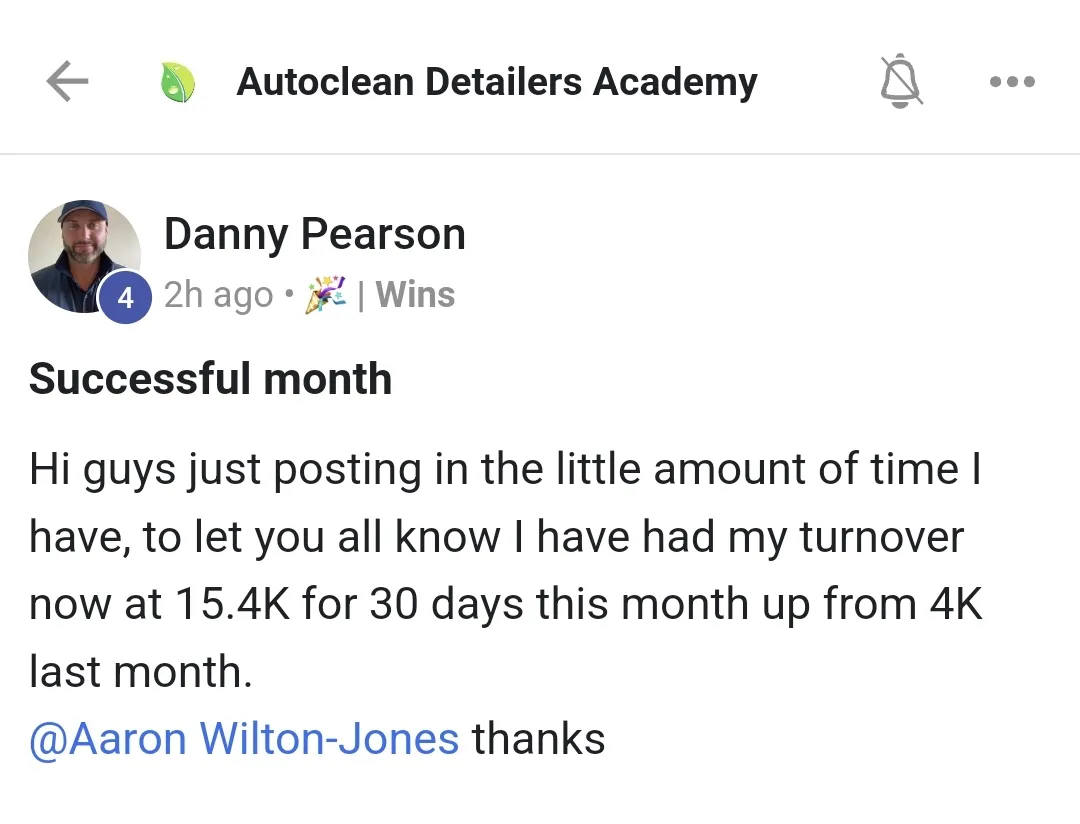
Danny Pearson is a perfect example. He posted his numbers in the community: $15,400 in 30 days, up from $4K the month prior. That’s not a small improvement. That’s what happens when the right services, the right pricing, the right lead flow, and the right follow-up all click at once.
I’ve noticed a clear pattern of people that are more active inside of the group calls, the chat, the community, and just pay more attention, are the people that turn this into a legitimate thing. The members who engage, who show up to calls, who ask questions, who actually take action, those are the ones who make this happen.
Month 5-6: Stabilizing Above $10K and Building Toward Scale
Hitting $10K once is great. Staying above $10K is the real game. This is where Gear 5, Systems and Operations, becomes critical.
At this stage, we’re looking at things like: Can you tell me your revenue off the top of your head? Do you know your cost per lead? Do you know how many follow-ups it takes on average to close a Meta ad lead? If you can’t answer those questions, you’re still guessing. And guessing doesn’t scale.
The members who stabilize above $10K are the ones who start thinking about the business differently. They stop trading time for money on every single job and start building assets. A Google Business Profile with 50 or 100 five-star reviews is an asset. An Instagram page with consistent content and social proof is an asset. A CRM with hundreds of contacts and an automated follow-up sequence is an asset.
One member I coach recently hit 100 five-star reviews on his Google Business Profile and is running $15,000 months with a fully kitted out van. That didn’t happen because of one tactic. It happened because every gear was turning.
The path from $10K to $20K and beyond usually involves adding ceramic coatings if you haven’t already, scaling up ad spend, potentially running Google ads alongside Meta, and eventually looking at hiring someone. But those are all just extensions of the same five gears. Nothing fundamentally changes. You just turn each gear harder.
The Real Lesson: It’s Not One Thing, It’s Every Gear Turning Together
Most detailers don’t have a detailing problem. They have a demand and follow-up problem. The skill is usually there. What’s missing is the system that turns that skill into predictable, repeatable revenue.
I’ve said this before and I’ll keep saying it: if you follow the process, you’ll stop relying on luck. The detailers who go from $3K to $10K in six months are not superhuman. They don’t have some special advantage. They just install a system and work it consistently.
The 5-Gear Growth System isn’t complicated. Lead Generation brings people in. Lead Nurture builds trust. Sales converts interest into booked jobs. Delivery and Retention keeps customers coming back. Systems and Operations holds the whole thing together. That’s it.
If you’re sitting at $3K a month right now, the gap between where you are and $10K is not as big as you think. But it does require you to stop doing what you’ve been doing and install something different. You’ve got the skill. You just need the system.
If you want to see exactly how the Academy helps detailers install this system, book a free strategy call. We’ll look at where you’re at, figure out which gear is broken, and map out a plan to get you to $10K per month.
Frequently asked questions
How long does it realistically take to go from $3K to $10K per month as a car detailer?
Based on Academy member data, most detailers who follow the process consistently reach $10K within 3 to 6 months. The timeline depends heavily on your starting point, service mix, and how quickly you implement the system. Members who are already doing full details and add ceramic coatings tend to get there faster because of the higher average order value.
Do I need to offer ceramic coatings to hit $10K per month detailing?
Not necessarily, but it makes the math significantly easier. In my coaching experience, one Academy member hit $10,740 in a single month doing just full details and interiors. However, offering ceramic coatings at $1,000 or more per job means you only need 10 customers instead of 50 or 60 at lower price points.
What does the 5-Gear Growth System actually include?
The five gears are Lead Generation, Lead Nurture, Sales, Delivery and Retention, and Systems and Operations. Each gear addresses a specific part of running a profitable detailing business. The system is designed so that if even one gear isn't turning, you can identify and fix it rather than guessing at what's wrong.
How much should I spend on Meta ads to get detailing leads in 2026?
Ad spend varies by market and campaign type. Inside the Academy, we start members with a full detail campaign and adjust based on results. The cost per lead depends on your location, your ad creative, and how well your profile and landing page build trust. We focus on making the overall system profitable rather than fixating on one cost-per-lead number.
What is a good close rate on Meta ad leads for car detailing?
Close rates on Meta ad leads are lower than referral or Google leads because these are cold prospects who may not have been actively searching. In my coaching experience, the close rate improves dramatically when you implement speed to lead, meaning calling within minutes, and have a structured follow-up cadence in your CRM.
Can I scale a detailing business in a small or rural area?
Yes. One Academy member, Leroy Pertab, operates in a smaller rural area and hit over $21,000 in a single month. The key in smaller markets is focusing on high-ticket services like ceramic coatings and paint correction so you need fewer customers to hit your revenue target. Your average order value matters more than your population size.
What's the biggest mistake detailers make when trying to scale past $5K per month?
Based on Academy member data, the biggest mistake is chasing volume at low prices instead of restructuring services and pricing. Detailers doing 40 jobs a month at $150 each are burning out for $6K. Restructuring to fewer, higher-ticket services is almost always the fastest path to breaking through that ceiling.
Do I need a website to start getting detailing customers in 2026?
Not to get started. A Google Business Profile ranks higher than most websites for local search and it's free. Combined with an optimized Instagram page and Meta ads, you can reach $10K per month or more without a traditional website. A website becomes more valuable later for long-term organic growth, depending on your market.